
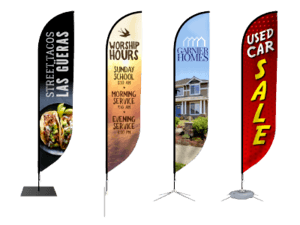











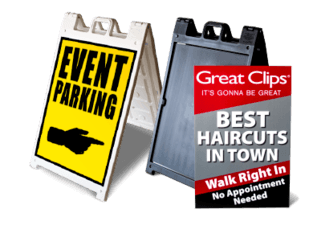


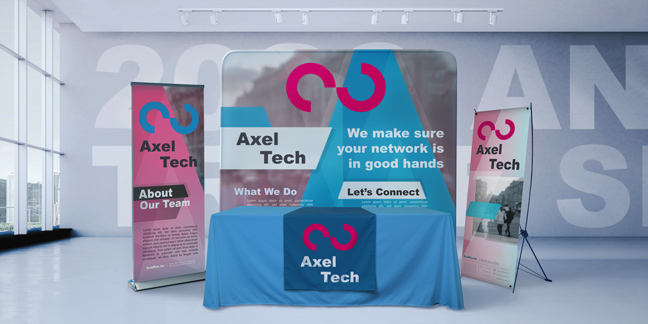
Trade show booth displays are the signs, banners, and branded surfaces that help your booth stand out in a crowded event space. They do more than “look nice.” The right display setup can help people spot you from across the aisle, understand what you offer in seconds, and remember your brand long after the show ends.
The key is that not all trade show booth displays serve the same purpose. Some are designed to create a bold booth backdrop. Others are made to highlight a single message, guide foot traffic, or support a product demo.
This guide breaks down the most common display types, what they’re for, and when you’ll typically see them used.
Common Trade Show Booth Display Setups
These examples show how display types are often paired together for different booth formats.
Tabletop Booth Setup Example
A typical tabletop booth setup might include:
- Table covers for clean branding
- Tabletop banner for visible messaging
- Counter card for QR codes, promos, or lead capture
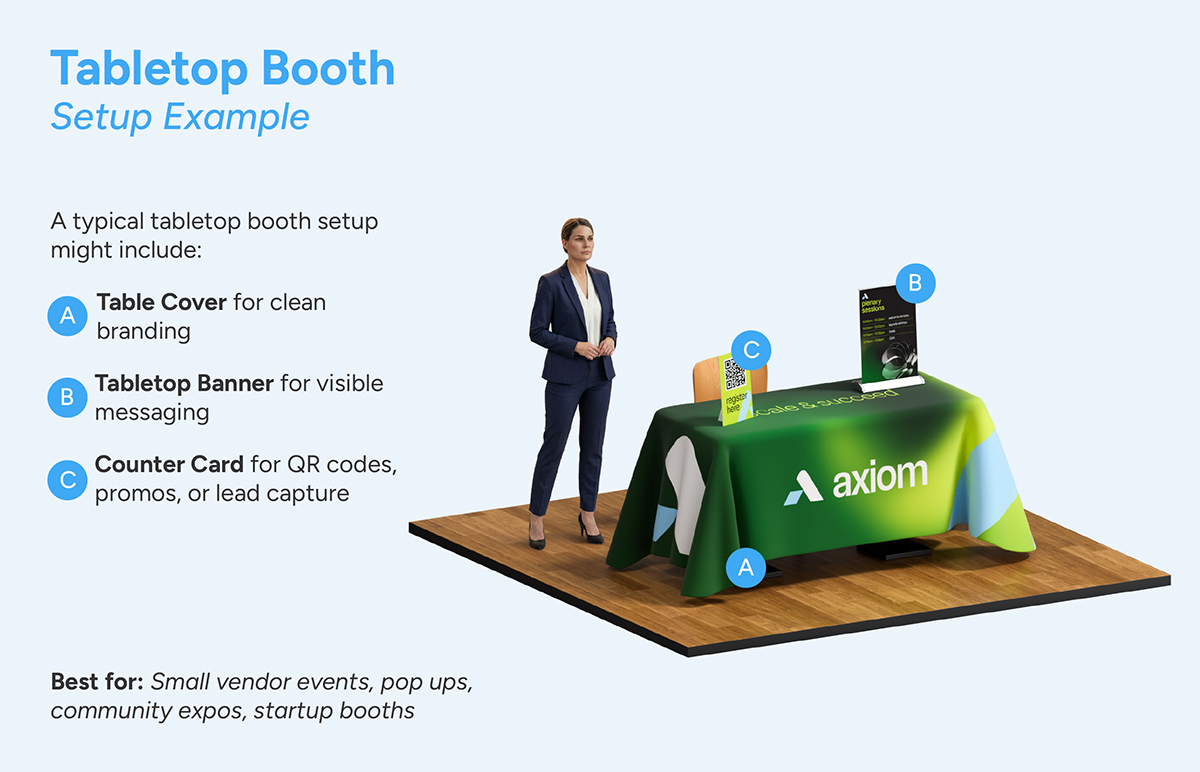
Best for: Small vendor events, pop ups, community expos, startup booths
Standard Inline Booth Setup Example
A standard inline booth setup often includes:
- Pop up display as the booth backdrop
- Two retractable banner stands for supporting messages
- Table cover to complete the front-facing branding
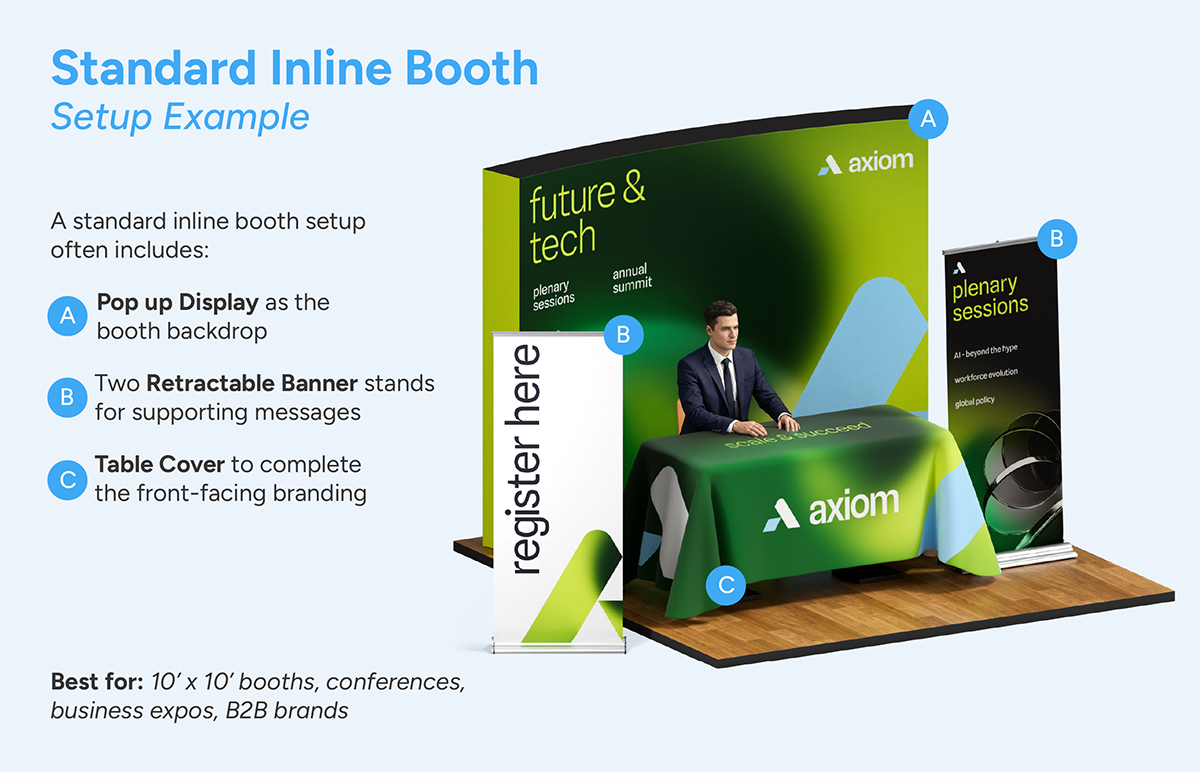
Best for: 10’ x 10’ booths, conferences, business expos, B2B brands
Large Booth Backdrop-focused Setup Example
A backdrop-focused booth setup often includes:
- Backlit pop-up display to dominate visually
- Retractable banners near the aisle for quick offers
- Poster stands for product info and deeper details
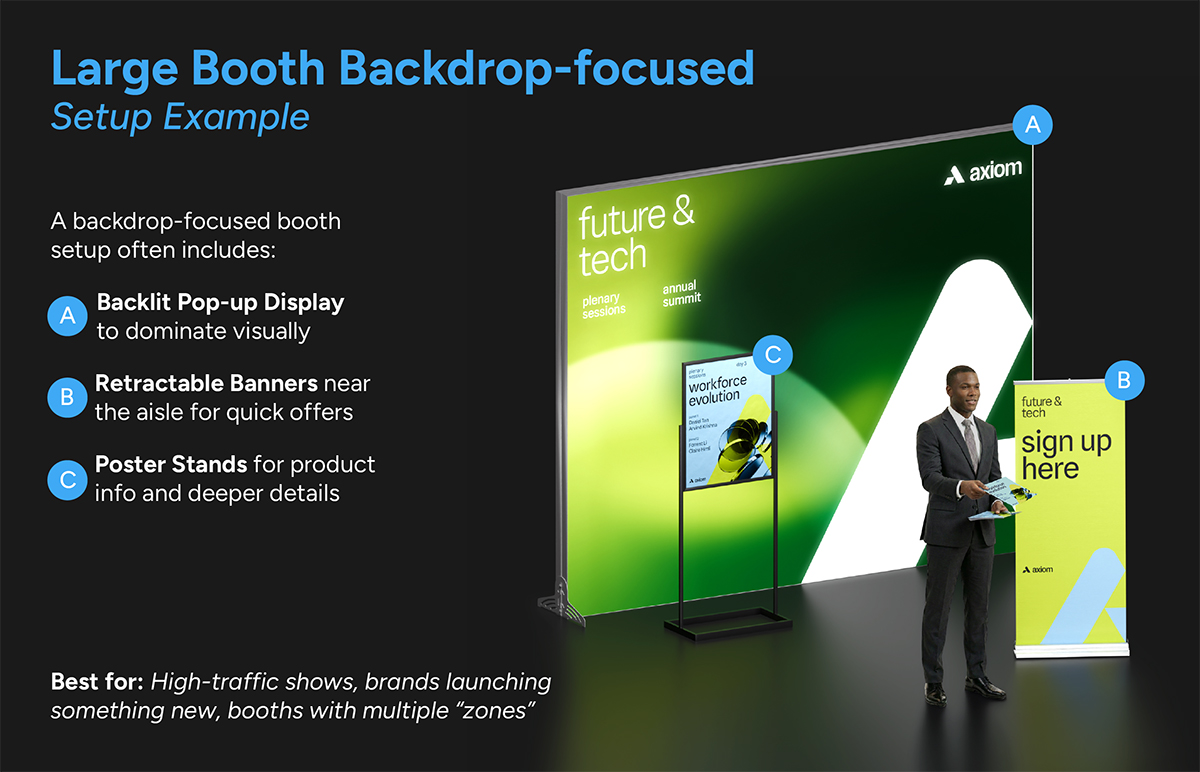
Best for: High-traffic shows, brands launching something new, booths with multiple “zones”
Pop Up Displays
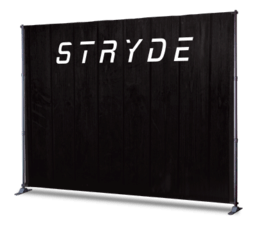
A pop up display is a large-format display system designed to create an instant branded backdrop for your trade show booth. It’s one of the most common “main wall” visuals used in standard inline booths and larger event spaces.
How It Functions
Pop up displays work as your booth’s visual anchor. They usually sit at the back of your space, giving you a clean, consistent background for:
- Your logo and brand colors
- A tagline or main message
- Product imagery or lifestyle visuals
Backlit pop up displays add internal lighting, which helps your branding pop even under harsh convention center lighting.
Common Sizes
Pop up displays are commonly sized to fit standard trade show booth widths, such as:
- 8’ wide
- 10’ wide
- Larger backdrop-style setups depending on booth space
(Exact sizing options vary by product style, but they’re typically designed to match standard booth footprints.)
Example Use Cases
Pop up displays are commonly used for:
- 10’ x 10’ booths that need a strong branded wall
- Brands that want a clean, “finished” look without building a custom booth
- Product launches, conferences, and high-traffic expos
- Photo-ready backdrops for content, staff photos, and quick booth videos
Banner Stands
Banner stands are some of the most flexible trade show booth displays because they’re easy to move, quick to set up, and great for adding messaging without redesigning your whole booth.
Retractable Banner Stands
A retractable banner stand is a vertical banner system that rolls up into its base when not in use, then pulls up and locks into place during setup.
How It Functions
Retractable banners are often used as “instant messaging” signage. They can stand on their own and are easy to place:
- At the front corners of a booth
- Near an aisle to attract passersby
- Behind a table for a clean branded backdrop (especially in smaller booths)
Because the banner retracts into the base, it’s also one of the easiest displays to transport.
Common Sizes
Retractable banners are most often found in standard widths like:
- 33″ wide (trade show standard)
- Wider formats for bigger messaging
- Most are tall enough to be seen easily above a table and from across a walkway.
Example Use Cases
Retractable banner stands are commonly used for:
- First-time exhibitor booths
- Highlighting one main offer: “Free Samples,” “Book a Demo,” “New Product”
- Booth entrances to catch attention
- Directional messaging in shared booth spaces
X Banner Stands
An X banner stand is a lightweight stand that holds a printed banner using tension at the corners, forming an “X” shape behind the graphic.
How It Functions
X banner stands are a simple, portable way to display messaging. The graphic stays stretched tight across the stand, making it easy to keep your message readable without needing a heavy base system.
They’re especially useful when you want multiple signs around a booth but need something lightweight and easy to carry.
Common Sizes
X banner stands typically come in compact formats such as:
- Medium sizes like 24” x 63” and 24” x 72” that work well inside booth spaces
- Larger sizes like 48” x 84” for bigger messaging and improved visibility from farther away
Example Use Cases
X banner stands are commonly used for:
- Budget-conscious setups that still need clear signage
- Secondary messaging like feature highlights or pricing
- Short-term events or one-day exhibits
- Booths where the display needs to move often (multi-location events)
Poster Stands
A poster stand is a display stand designed to hold a printed poster upright, usually in a frame or mounted format.
How It Functions
Poster stands help you present information that people can read up close, making them useful for more detailed messaging than a typical banner. They’re often placed where attendees naturally pause, like near:
- Product tables
- Demo stations
- Lead capture areas
They also create a more “informational” feel, which can be helpful if your booth needs to explain a process, menu of services, or product specs.
Common Sizes
Poster stands are often used with poster dimensions like:
- 24″ x 36″
- Other poster formats depending on your content needs and viewing distance
Example Use Cases
Poster stands are commonly used for:
- Product features and comparison charts
- Pricing menus or service lists
- Event schedules or speaking times
- Step-by-step explanations (perfect for tech, healthcare, education, and B2B brands)
Tabletop Displays
Tabletop displays are designed for booths where your main interaction happens at the table, whether you’re doing demos, signing people up, or handing out materials.
Table Covers
A table cover is a branded fabric cover that wraps your trade show table, turning it into a clean, professional display surface.
How It Functions
Table covers provide an immediate brand presence at eye level and below. Instead of showing an empty table or exposed storage underneath, a branded table cover helps your booth look more intentional and polished. It also helps unify your booth visually when paired with banners or pop-up displays.
Common Sizes
Table covers are commonly made for standard-sized event tables like:
- 6’ tables
- 8’ tables
Example Use Cases
Table covers are commonly used for:
- Tabletop booths in small vendor areas
- Booths that rely on samples, brochures, or product displays
- Registration or check-in stations
- Brands that want a professional look without large backdrops
Counter Cards
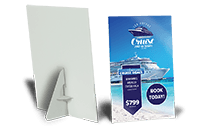
A counter card is a small, rigid sign designed to sit directly on your table or counter surface.
How It Functions
Counter cards work as “close-range signage.” They’re ideal when attendees are already at your booth and need a clear next step or quick information without asking. They can also support your booth staff by answering the most common questions automatically.
Common Sizes
Counter cards typically come in compact tabletop sizes such as:
- Small sign formats that fit easily beside brochures, samples, or tablets
Example Use Cases
Counter cards are commonly used for:
- QR codes for sign-ups, menus, or landing pages
- Promo callouts like “Show Special Pricing”
- Lead capture prompts like “Enter to Win”
- Instructions like “Scan Here for Our Catalog”
Tabletop Banners
A tabletop banner is a smaller banner display designed to sit on a table, offering a vertical branded sign without needing floor space.
How It Functions
Tabletop banners give you height and visibility on a crowded table. They’re ideal for adding branding above brochures, products, or sign-up sheets, especially when your booth doesn’t allow large floor displays.
They also work well as part of a layered setup: tabletop banner + table cover + counter card.
Common Sizes
Tabletop banners usually come in smaller formats than standard banner stands, such as:
- Shorter height designs meant for tabletop viewing
Example use cases
Tabletop banners are commonly used for:
- Shared booths where floor signage is limited
- Demo tables and sampling stations
- Brand messaging for small booths
- Pop up markets and community events
Trade Show Booth Display Terminology
Trade Show Display Banners vs. Trade Show Display Signs
- Trade show display banners usually refer to large, printed graphics on flexible material (often vertical, attention-grabbing, and message-driven).
- Trade show display signs is a broader term that can include banners, posters, tabletop signage, and other printed display formats.
If you’re searching online, both terms are useful depending on whether you want a banner-style display or any kind of booth signage.
Booth Backdrop vs. Banner Stand
- A booth backdrop is a large background display that defines your space (often a pop up display).
- A banner stand is usually a standalone vertical sign used for messaging and visibility (like retractable banners or X banner stands).
Tabletop Display vs. Floor Display
- A tabletop display sits on a table and is meant for close-up viewing.
- A floor display stands on the ground and is designed to be seen from a distance.
Where to Find Trade Show Booth Displays
If you’re building a booth display setup, you can find a full range of trade show booth display solutions at Signs.com, including pop up displays, banner stands, and tabletop displays.
To explore options, visit the Signs.com trade show signs collection: https://www.signs.com/trade-show-signs/.
Trade show booth displays aren’t one-size-fits-all because trade shows aren’t either. Some booths need a bold, branded backdrop that holds attention from across the aisle. Others need portable signs that can be reused across multiple events, and many need compact tabletop displays that support conversations up close.
By understanding the different types of trade show booth displays, it becomes much easier to build a setup that fits your space, supports your message, and helps your booth look polished and professional at any event.