
Americans still believe signs matter — but confusion, overload, and tone increasingly determine which rules people actually follow.
Illustrated city scene with pedestrians and blue public signage, including directional signs, crosswalk symbols, and storefront wayfinding graphics.
Every American knows what a stop sign means, and that consistency is intentional. Regulators ensure that traffic signs are standardized across the country so drivers can recognize and react to signs instantly, no matter where they are. Despite how near-universal our signs are, many Americans ignore them, especially in places where their messages matter most — on roads, in parking lots, and in shared public spaces.
That disconnect is becoming harder to ignore as businesses, cities, and property managers rely on more signage than ever. But adding more signs does not automatically create more order. In many cases, Americans say the opposite is happening: signs are becoming background noise.
To better understand how people actually respond to signage, Signs.com surveyed 1,000 U.S. adults about their behavior around signs, sign fatigue, and reactions to public rule-breaking. The results reveal a growing credibility gap between the signs Americans see every day and the ones they actually pay attention to.
Key Takeaways
- Nearly 96% of Americans say rules and signage are important for maintaining order. Yet, 40% admit to knowingly ignoring a sign, even when they believe the rule is valid, rising to 64% among Gen Z.
- About 1 in 4 (25%) ignored a road sign in the past month. Among drivers, 75% admit to speeding, 43% to rolling through stop signs, and 41% to running a yellow light they could have stopped at.
- Half of Americans (50%) say they've ignored a posted rule because they assumed it was there for liability reasons, not because it actually needed to be followed. That climbs to 60% among millennials and 58% among Gen Z.
- More than a third (34%) say they've become less likely to notice or follow signs simply because there are too many of them, with “sign fatigue” hitting Gen Z (40%) and millennials (40%) at more than twice the rate of baby boomers (19%).
- Polite and friendly signs make 71% more likely to comply, outperforming direct and authoritative (67%), humorous (60%), and passive-aggressive (39%). About 1 in 4 say passive-aggressive signs annoy them and 17% say they make them less likely to follow at all.
- The #1 reason Americans ignore signs isn't inconvenience — it's unclear or confusing wording (61%). This ranks ahead of feeling the situation is low risk (55%), being in a hurry (54%), and seeing the rule as unnecessary (53%).
- The top drivers of sign compliance are clarity (42%), personal safety relevance (33%), and visible enforcement (28%). About 82% believe they follow signs more often than other people do.
- When someone breaks a rule in public, only 1 in 10 says something directly. Instead, 32% silently feel annoyed, 33% notice without reacting, and 27% quietly adjust their own behavior.
Signs For Thee, But Not For Me
Drivers seem to take a “do as I say, not as I do” attitude toward road signs. While the vast majority know how important it is to follow the laws, many choose to ignore them anyway. We looked deeper into this contradiction among our respondents, and found that many Americans believe these rules are made to keep other drivers in line
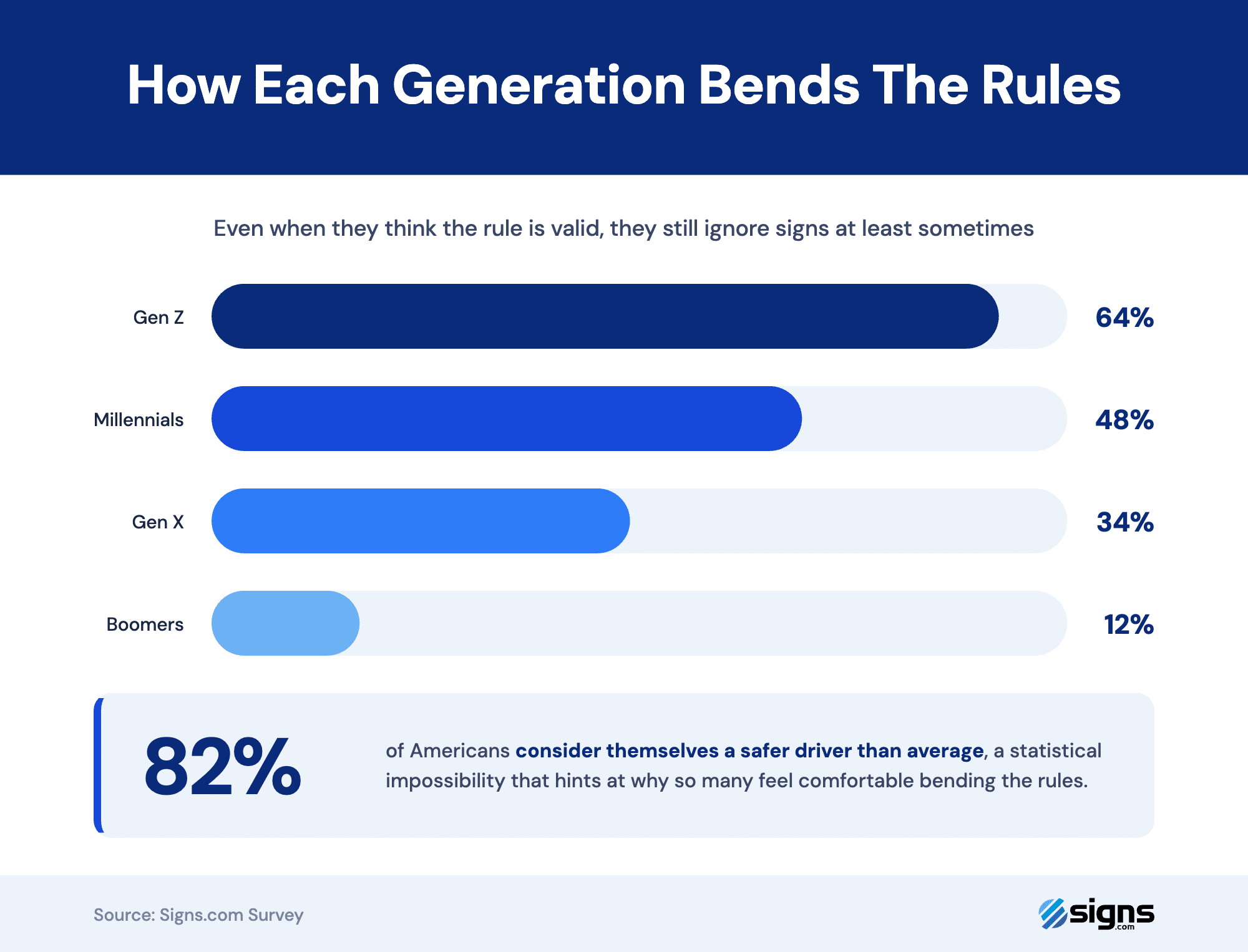
Gen Z ignores signs the most at 64%, while 82% of Americans consider themselves safer drivers than average.
Almost all Americans (96%) agree that signage is important, with 61% saying it is very important for maintaining order. This sentiment was consistent across demographics, with at least 57% of every generation and gender group agreeing that signs play an important role in public safety.
Similarly, most Americans (82%) think they drive more safely than the average person, rising to 86% among millennials. Meanwhile, baby boomers were the least confident in their driving skills, with only 79% rating themselves as safer-than-average drivers. It turns out, though, that they may be the most self-aware generation, because many Americans only respect these signs in theory.
Despite most people saying signs were important, 40% admitted to ignoring road signs at least sometimes. Another 48% said they rarely ignore road signs, but it’s still happening. Only 18% overall said they always follow every sign they see. Despite this, 42% believe that they follow signs much more often than other drivers, showing the disconnect between self-perception and actual behavior.
Gen Z respondents were the most likely to purposefully ignore signs, with 64% admitting they do so at least sometimes, followed by millennials at 48%. Meanwhile, women were far more likely to say they had not ignored any signs, at 57% compared to 40% of men. Younger male drivers seem to be the most likely to ignore posted signs, but people of all genders and ages seem to end up doing so at least once.
Why Drivers Ignore the Signs Meant to Protect Them
If there’s one place where Americans value safety above all else, it’s on the road. Yet, many drivers ignore the very signs placed there to protect them and their neighbors. Here are the signs our respondents were most likely to ignore, and whether or not they still considered themselves a good driver.
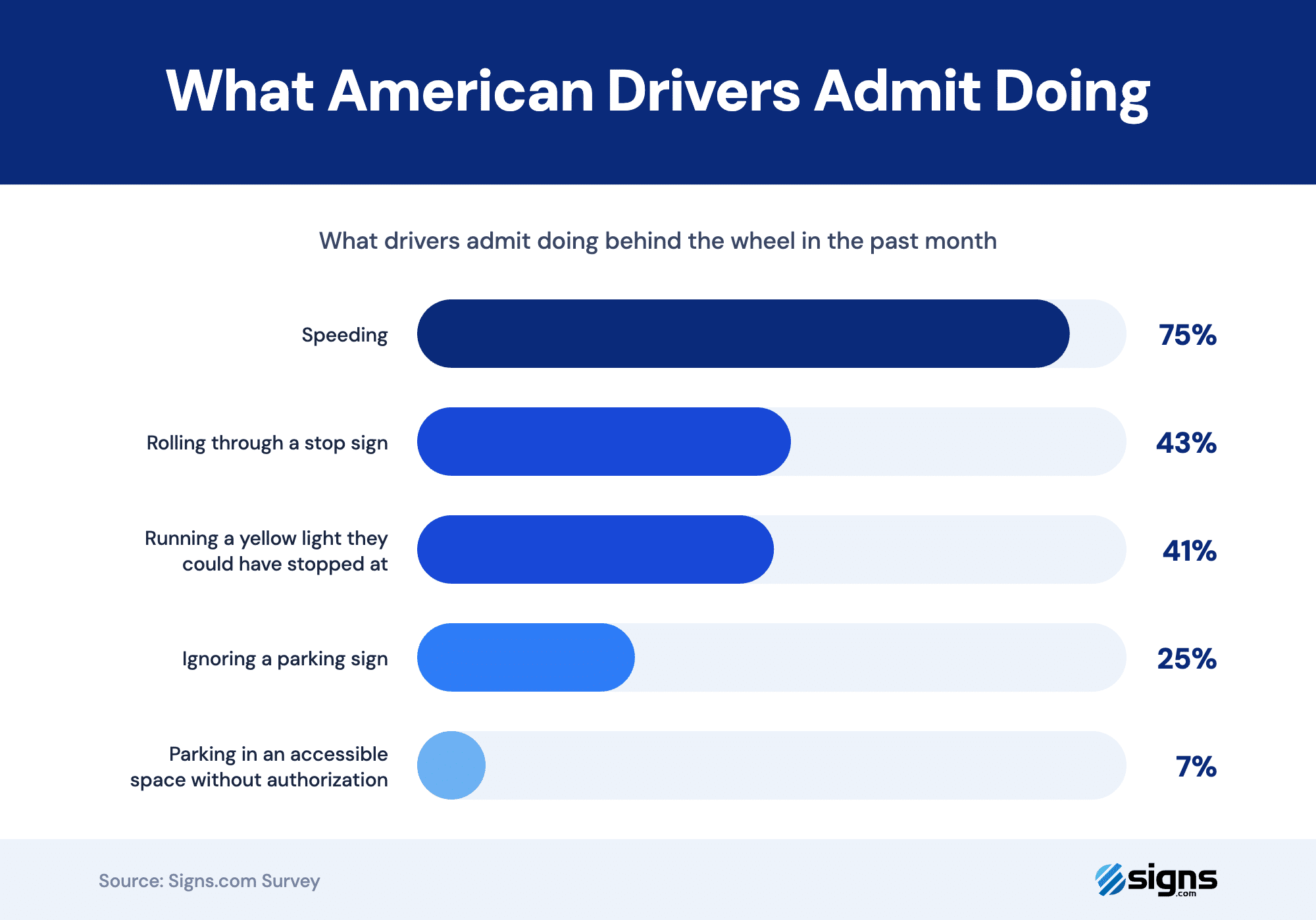
Admitted driving violations, with speeding as the most common offense at 75%.
A quarter of Americans (25%) admitted to ignoring a road sign in the past month, making roads the most common setting for sign non-compliance in the survey. Among those drivers, speeding was by far the most common violation, with 75% admitting they’d exceeded the speed limit. Another 43% said they rolled through a stop sign, while 41% admitted to proceeding through a yellow light they should have stopped for.
Parking lots were the second space where drivers broke the rules: 25% admitted to ignoring signs in parking situations, including 7% who said they parked in an accessible or handicapped space without authorization. This can create real problems when the people who require those spaces are unable to access them.
Men consistently reported riskier driving behaviors than women: 81% of men admitted to speeding compared to 69% of women. Men were also more likely to roll through stop signs (45%) and run yellow lights (44%). Even so, 83% of men considered themselves safer than the average driver, nearly identical to the 81% of women who said the same. This misplaced confidence shows why, in 2023 alone, 72% of fatal car accidents in the U.S. involved a male driver. Men uniformly make riskier driving decisions — but are the least likely to admit it.
Interestingly, baby boomer respondents were the most likely to speed, with 92% admitting they exceeded the speed limit. Millennials, meanwhile, were most comfortable rolling through stop signs (46%) and running yellow lights (47%). These generations are statistically more likely to break these rules, but they are not outliers. American drivers expect perfect driving from their peers — but do not hold themselves to the same standards.
When Too Many Signs Become Part of the Problem
The goal of traffic signs is to direct traffic and ensure drivers pay attention to the road ahead — but what happens when these signs actually pull their attention away? While signs are necessary for a safe road, a lot of people may end up ignoring them if there are too many along a street.
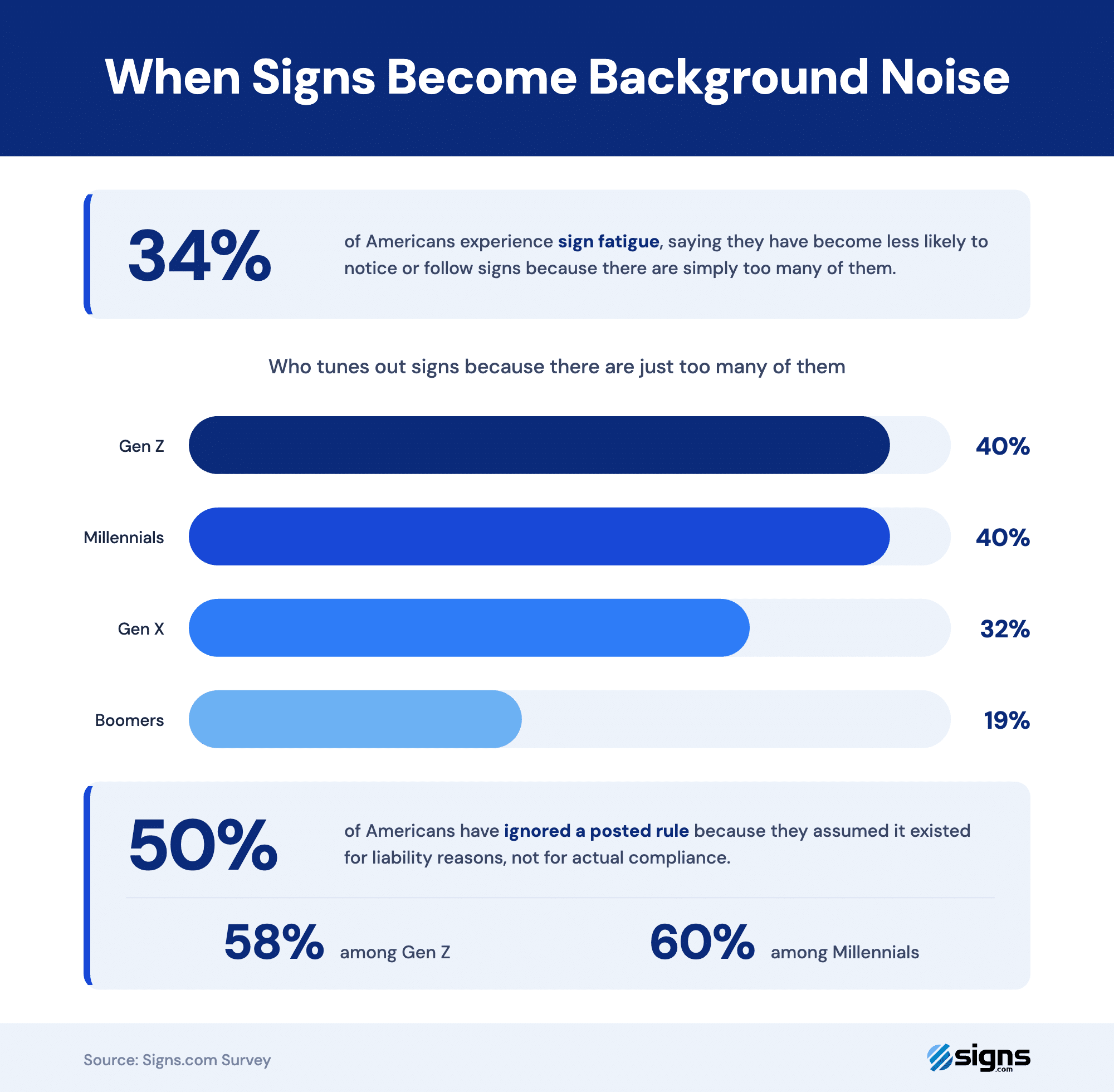
Illustrating that 34% of Americans experience sign fatigue, a sentiment highest among Gen Z and Millennials.
One-third of Americans (34%) admitted they have become less likely to notice or follow signs because there are simply too many of them. Another 28% said they often encounter excessive signs, while 31% regularly see signs that feel unnecessary or overly obvious. Nearly one-third (31%) said they frequently encounter signs that come across as aggressive or threatening in tone.
Sign fatigue was especially common among younger generations. Up to 40% of both Gen Z and millennials said they have tuned out signs due to overload, compared to 32% of Gen X and just 19% of baby boomers. Men were also significantly more likely to experience sign fatigue than women, at 39% versus 27%. Perhaps this is why men are so much more likely to roll through a stop sign — they believe they’ve seen too many of them.
The problem may also come down to credibility. Half of Americans (50%) said they have dismissed a posted rule at least sometimes because they believed it existed more for liability reasons than for people actually to follow. That skepticism was even higher among younger generations, rising to 58% among Gen Z and 60% among millennials. When people begin to assume signs are unnecessary, exaggerated, or performative, they can end up accidentally ignoring a sign that is important.
The Psychology Behind Effective Signage
So, how do drivers decide which signs to obey and which to ignore? For many, it isn’t a conscious decision — it’s a split-second reaction. Some bend the rules because they assume they won’t get caught, but others may miss a sign entirely by accident. Here’s what makes drivers notice a sign — and do what it says.
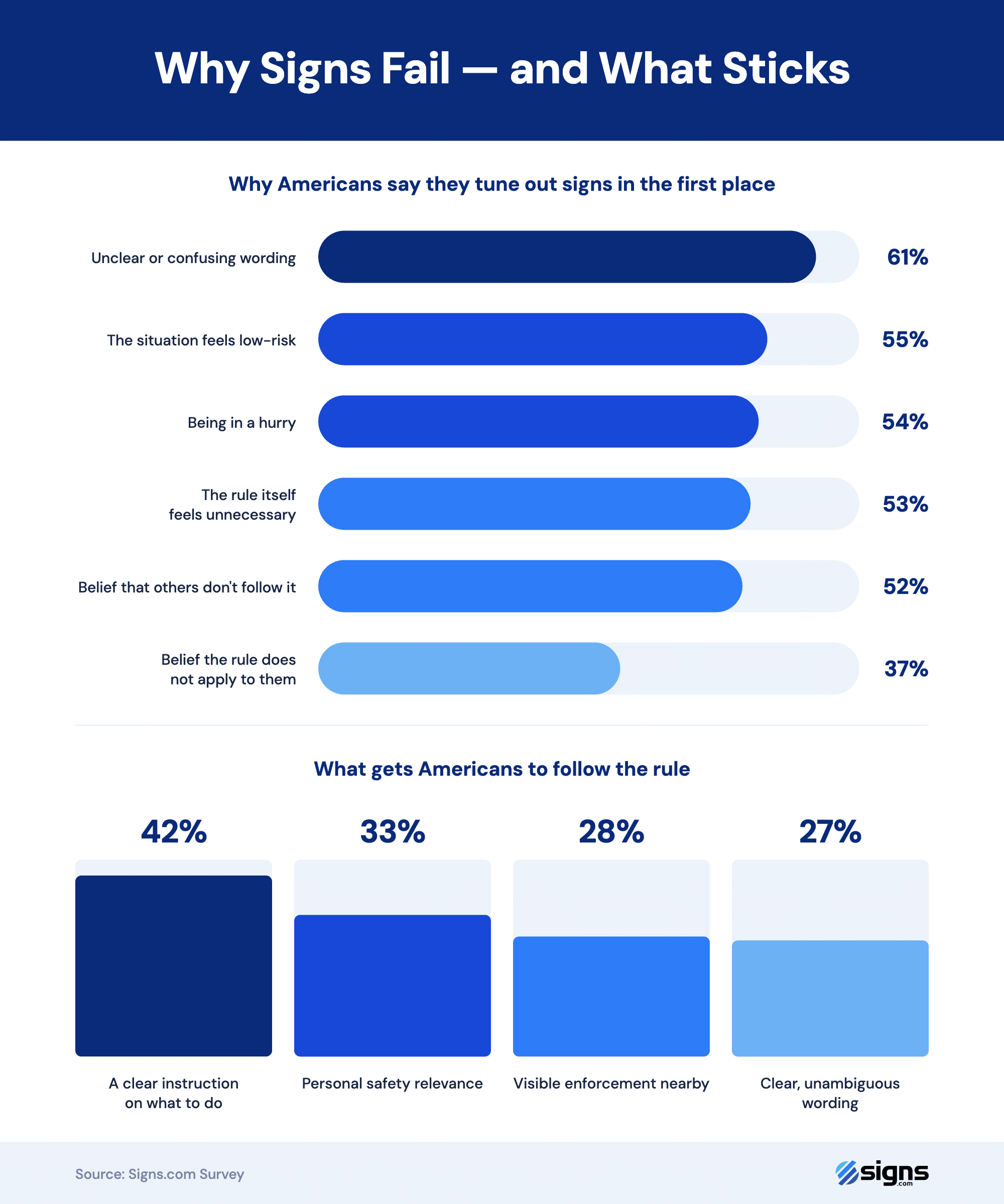
Explaining that unclear wording causes people to ignore signs, while clear instructions encourage compliance.
Americans are most likely to comply with a sign when it clearly states what to do (42%), relates to personal safety (33%), or is backed up by visible enforcement like cameras or staff presence (28%). Another 27% said clear, unambiguous wording makes them more likely to obey a sign. It turns out, it’s easy to follow the rules when the rules are clearly communicated to you — especially when done by sign.
At the same time, many Americans said many of the signs they encounter fail to meet those standards. A majority (61%) said unclear or confusing signage leads them to ignore a sign entirely, making confusion the top reason people disregard posted signs. Social influence followed closely behind, with 52% saying they are more likely to ignore a sign if they think others don’t follow the rule either. Other common reasons included the situation feeling low-risk (55%), being in a hurry (54%), and the rule itself feeling unnecessary (53%).
External pressure and social behavior influenced Gen Z respondents the most: 43% said seeing others ignore a sign affects whether they comply, compared to just 9% of baby boomers. Younger generations were also more likely to ignore confusing signs, with 66% of Gen Z and 62% of millennials bypassing unclear signs. This underscores how important it is that signs be concise, clear, and easy to read. In these cases, the responsibility is on the creator of the sign to communicate effectively.
Why Polite Signs Win and Passive-Aggressive Ones Backfire
You’ve seen them before: signs that say things like “Customer Parking Only; All Others Will Be Eaten By Dinosaurs” or “Don’t Drive Drunk, Your Dog Won’t Understand Why You Never Came Home”. When people get tired of giving the same directions in the same way, they start to get sarcastic or passive-aggressive. The thing is, these signs often become less effective than the safe, straightforward option.
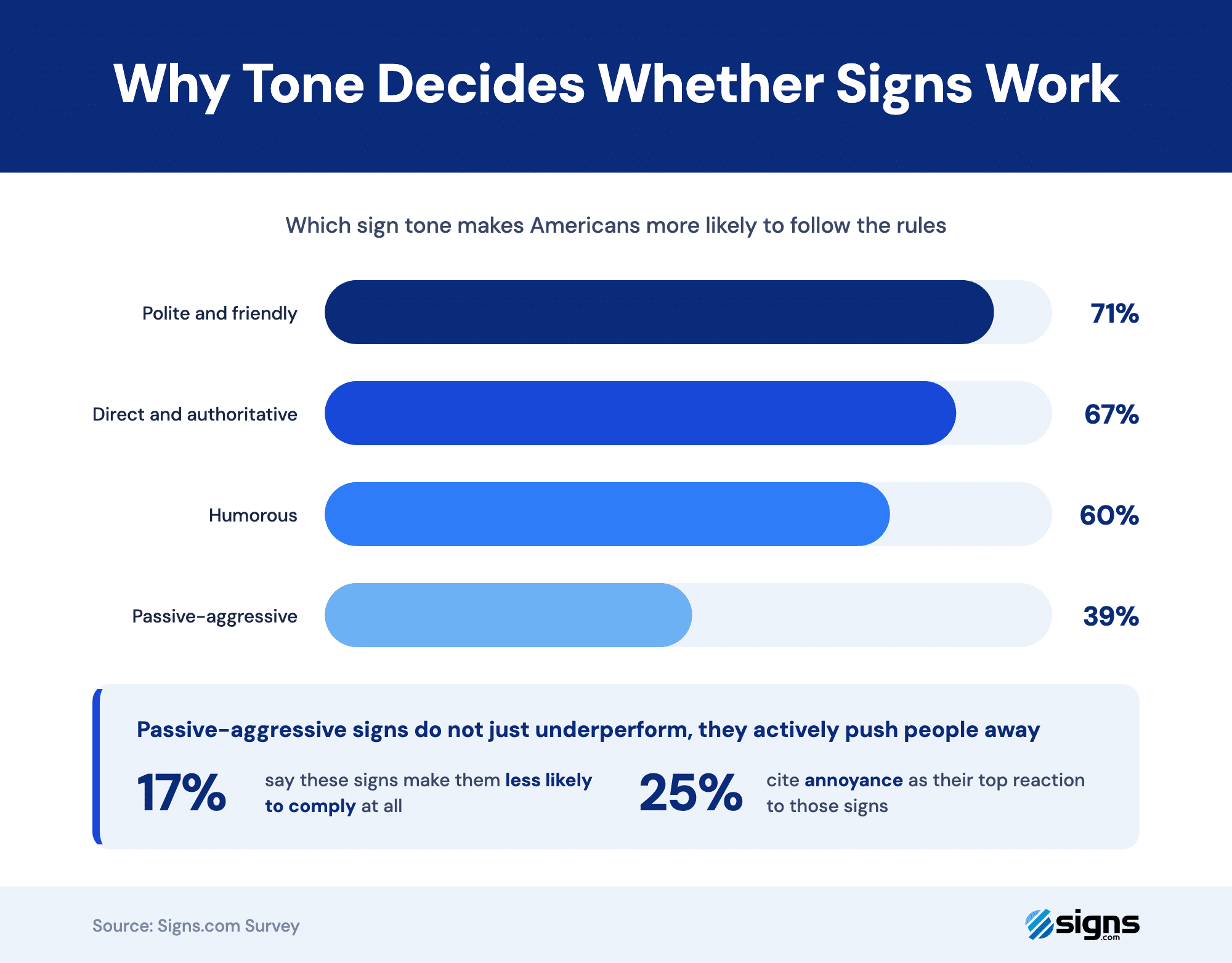
Showing polite sign tones encourage the most compliance (71%), whereas passive-aggressive tones are the least effective.
Nearly half of Americans (46%) said passive-aggressive signs have no impact on whether they follow a rule, while another 17% said those signs actually make them less likely to comply. The most common reaction to passive-aggressive signage was annoyance, cited by 25% of respondents. Instead of encouraging compliance, signs built around guilt, sarcasm, or threats make people tune out.
Friendlier approaches performed far better. Most respondents (71%) said polite and friendly signs make them more likely to comply. Direct and authoritative signs also performed well, with 67% saying they’ll comply. Humor proved surprisingly effective, as well: 60% of Americans said humorous signs make them more likely to follow the rules, illustrating that entertaining signage can succeed where passive-aggressive messaging fails.
Tone matters even more with younger audiences. Gen Z was the most receptive to humorous signs, with 68% saying humor increases their likelihood of compliance, compared to 50% of boomers. Passive-aggressive signs backfired most heavily among Gen X, where 19% said those signs make them less likely to follow the rule. Women were slightly more likely than men to react negatively to passive-aggressive signs as well, at 18% to mens’ 15%. Even if these signs convey the rules in a lighthearted way, they’re working against their intended purpose.
What Happens When Someone Breaks a Public Rule
When someone ignores a posted rule in public, most Americans don’t say a word. They share a judgmental look with their friends, or roll their eyes internally, but never confront the offender. Even though this prevents conflict, it also prevents the sign-ignorer from facing the necessary social friction they can learn from. This makes it easier for people to continue ignoring rules and laws without immediate consequences.
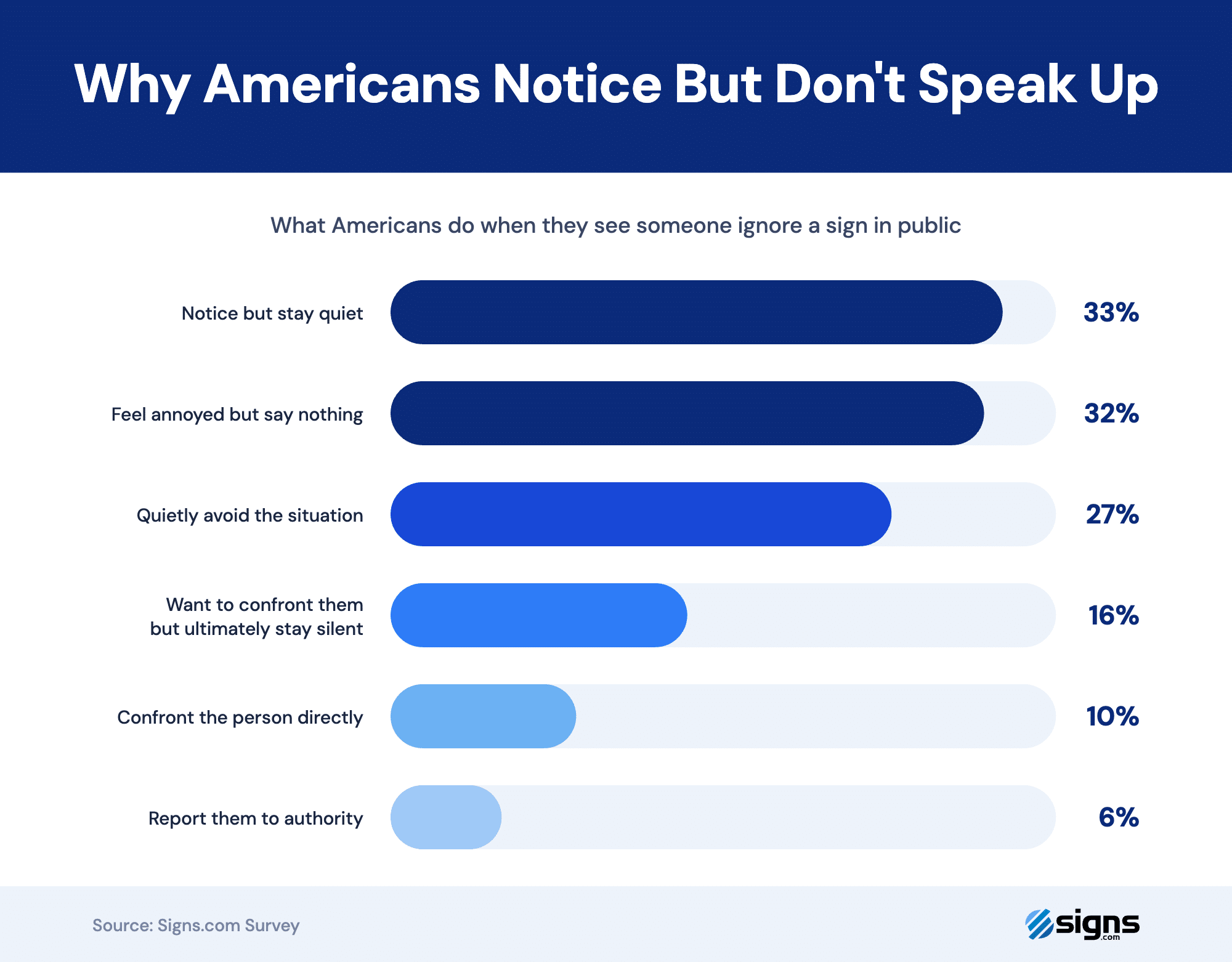
Revealing that most Americans stay quiet or silently annoyed when they see someone ignoring a public sign.
If they see someone disobey a sign in public, a third of Americans (33%) said they notice the behavior but do not react, while another 32% said they feel annoyed but stay silent. Another 27% avoid the situation altogether. Only 10% said they are willing to directly confront the person breaking the rule, and just 6% would report them to an authority. Another 16% admitted they have wanted to confront someone before, but ultimately chose not to.
People are avoiding conflict — but often, for good reason. Among Americans who have confronted someone over rule-breaking behavior, 6% were ignored, 4% said nothing changed, 4% said it only increased the tension. Another 4% ended up in a verbal argument with the rule-breaker. The collective 19% of Americans who have experienced these negative consequences may end up feeling like sticking up for what’s right isn’t worth the public battle.
Millennial respondents were the most likely to confront someone directly over breaking a rule at 12%. Baby Boomers, meanwhile, were the most passive despite being the generation most likely to follow signs themselves. Men were significantly more likely than women to confront someone directly, at 13% compared to 6%, and were also more likely to escalate into verbal arguments. Women are more likely to lie low and protect their own safety, whereas men are more comfortable standing up for public rules. After being conditioned to view anyone behaving erratically in public as a potential threat, women assess these situations more cautiously. Without that conditioning, men are more confident to challenge bad behavior directly, even if it leads to conflict.
When Signs Stop Working, Shared Spaces Start Breaking Down
We’ve found a growing communication problem in public spaces: Americans still believe signs matter, but they no longer treat them as credible. As signs become more excessive, unclear, or passive-aggressive, people become more likely to tune them out entirely. Because signs can do everything from directing traffic to warning drivers of a dead end ahead, regulators and business owners must ensure they do not contribute to the problem.
Effective signage is no longer just about visibility. People are less likely to comply when signs feel unnecessary, confusing, or if they notice a majority of other people ignore them. For businesses, property managers, and cities, this creates a challenge: signs must now compete for citizens’ attention.
Americans responded most positively to signage tied to safety, direct instructions, and respectful or even humorous communication styles. In contrast, vague wording and passive-aggressive messaging often caused people to disengage altogether. As public spaces become increasingly crowded with warnings, reminders, and restrictions, thoughtful signage plays a larger role than ever in how people stop, pay attention, and choose to comply.
Methodology
Signs.com surveyed 1,000 U.S. adults through an online poll conducted via Pollfish. The survey examined attitudes and self-reported behaviors related to signage, rule compliance, sign fatigue, sign tone effectiveness, and social responses to rule-breaking. Results were post-stratified and analyzed across demographic segments, including generation (Gen Z, Millennials, Gen X, and Baby Boomers), gender, and driving status where applicable. Percentages reflect self-reported data and may sum to more than 100% when multiple selections were allowed. Subgroup results with smaller sample sizes should be treated directionally.
About Signs.com
Signs.com is an online custom signage company that helps businesses, organizations, and individuals create professional signs, banners, decals, and visual displays for workplaces, retail environments, events, and public spaces. Our company specializes in customizable signage solutions designed to improve communication, branding, and visibility across both indoor and outdoor environments.
Fair Use Statement
The information and findings in this article may be shared for non-commercial purposes only. If you reference this research, please credit Signs.com and provide a link back to the original study with proper attribution.